
What Does a Virtual Medical Scribe Do?
A virtual medical scribe supports healthcare providers by capturing approved information from patient encounters and organizing it into an EHR-ready clinical note.
Common responsibilities include:
- Real-time encounter documentation
- Medical history documentation
- Medication and allergy updates as directed
- Physical exam documentation as directed
- Assessment and plan drafting based on provider direction
- Note formatting
- Chart organization
- Telehealth documentation
- Administrative documentation follow-up
- Preparing the note for provider review
A scribe supports documentation. The treating provider remains responsible for medical decisions and the accuracy and approval of the final clinical record.
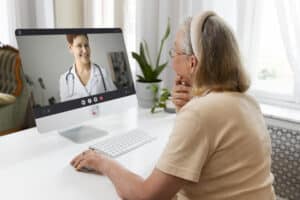 A scribe supports documentation. The treating provider remains responsible for medical decisions and the accuracy and approval of the final clinical record.
How Does a Virtual Medical Scribe Work?
A virtual scribe connects to the provider’s established documentation workflow from an offsite location.
In a real-time model, the scribe may listen to an authorized patient encounter through an approved communication platform and document the visit as it happens.
In an asynchronous model, the scribe may prepare documentation from an authorized recording or other approved encounter information after the visit.
The precise workflow depends on the practice’s technology, patient-consent procedures where applicable, privacy policies, documentation requirements, specialty, and provider preferences.
In either model, the final note should go back to the responsible healthcare provider for appropriate review and approval.
What Information Does a Virtual Medical Scribe Document?
A virtual medical scribe may document information communicated during the encounter according to the provider’s instructions and the practice’s established procedures.
Typical documentation can include:
- Chief complaint
- History of present illness
- Relevant past medical history
- Surgical history
- Medication information
- Allergies
- Family or social history
- Review-of-systems information when appropriate
- Physical exam findings communicated by the provider
- Assessment
- Plan
- Follow-up instructions
- Referrals
- Diagnostic information
- Other approved encounter details
The scribe’s responsibility is to accurately organize information—not independently decide what a patient’s diagnosis or treatment should be.
What Does Research Say About Virtual Medical Scribes?

What Does Research Say About Virtual Medical Scribes?
Virtual scribes have been studied as a way to reduce physicians’ electronic health record documentation burden.
A 2024 JAMA Network Open study of 144 physicians at Brigham and Women’s Hospital and Massachusetts General Hospital found virtual-scribe use was associated with 5.6 fewer minutes of total EHR time per appointment, 1.3 fewer minutes of note time, and 1.1 fewer minutes of after-hours EHR time per appointment.
The study included physicians who had used real-time or asynchronous virtual scribe services for at least three months.
The results should not be interpreted as guaranteed outcomes for every practice. The researchers found that effects differed among physicians, specialties, baseline documentation workloads, and implementation approaches.
The American Medical Association summarized this research as showing an approximately 16% reduction in EHR burden among virtual-scribe users.
What Is the Difference Between a Virtual Scribe and an In-Person Scribe?
Both models support medical documentation, but their working arrangements differ.
| Area | Virtual Medical Scribe | In-Person Medical Scribe |
|---|---|---|
| Location | Remote | Physically in clinic |
| Encounter access | Approved remote technology or workflow | Present during encounter |
| Office space | No onsite workstation required | Requires onsite space |
| Documentation | Real-time or asynchronous depending on model | Usually real-time |
| Provider communication | Remote communication workflow | In-person |
| Scaling | Can adapt to remote staffing arrangements | Depends on onsite staffing |
| EHR workflow | Secure remote access according to permissions | Onsite system access |
Neither approach removes the provider’s responsibility for the final medical record.
Is a Virtual Medical Scribe the Same as an AI Scribe?
No.
A human virtual medical scribe and an AI-powered ambient documentation system may both help create clinical documentation, but they are different models.
A human virtual medical scribe is a trained person who listens to or reviews approved encounter information and prepares documentation.
An AI or ambient scribe uses software, speech recognition, natural language processing, or generative AI to create a draft from the patient encounter.
Some healthcare organizations use one model, while others use combinations of human review and technology.
The important question for a healthcare practice is not simply whether a tool is called a “scribe.” The practice should evaluate:
- Who or what creates the draft
- How information is captured
- How errors are corrected
- Who reviews the documentation
- How PHI is handled
- What patient notice or consent is required
- Whether the system integrates with the EHR
- Who remains accountable for the final record
What Is the Difference Between a Virtual Medical Scribe and a Medical VA?
A scribe primarily focuses on clinical documentation support.
A Virtual Medical Administrative Assistant focuses on non-clinical administrative work such as:
- Appointment scheduling
- Patient communication
- Insurance verification
- Referral coordination
- Administrative EHR updates
- Inbox management
- Follow-up
- General office administration
These roles may work together, but they should not be treated as interchangeable.
If a physician’s main problem is after-hours charting, a scribe may be the appropriate role.
If the problem is overflowing phones, referrals, insurance verification, or scheduling, a medical administrative VA may be a better fit.
What Is the Difference Between a Virtual Scribe and a Medical Billing VA?
A virtual scribe documents the clinical encounter.
A Medical Billing Virtual Assistant works primarily within revenue-cycle and payer-related workflows.
Billing support may include:
- Eligibility verification
- Claim-status follow-up
- Payment posting
- Denial work queues
- Payer communication
- Routine patient billing inquiries
Good documentation can support a cleaner billing workflow because claims depend on adequate documentation, but a scribe should not automatically be expected to make independent coding or billing decisions.
What Should a Virtual Medical Scribe Not Do?
Clearly defining the role is especially important in healthcare.
Unless the individual separately holds another appropriate qualification and is authorized to perform that role, a medical scribe should not independently:
- Diagnose a patient
- Recommend treatment
- Prescribe medication
- Give medical advice
- Interpret laboratory results
- Make independent clinical decisions
- Perform the provider’s physical examination
- Change the provider’s assessment
- Sign a clinical note for the provider
- Independently approve orders
- Make professional coding decisions outside their qualifications
The provider determines the diagnosis and treatment plan. The scribe documents the provider’s information.
Who Is Responsible for the Final Medical Note?
The healthcare provider remains responsible for the final medical record according to applicable requirements and organizational policy.
The Centers for Medicare & Medicaid Services emphasizes that patient encounters should be documented completely, accurately, and on time.
A good virtual-scribe workflow therefore includes a defined review process.
The provider should be able to:
- Review the draft.
- Correct inaccuracies.
- Add missing information.
- Modify the assessment or plan.
- Complete required authentication or signature.
- Approve the final record.
Medical Staff Relief’s Remote Medical Scribe workflow follows this approach: scribes prepare documentation while providers review and approve the note before it becomes the final clinical record.
How Does a Virtual Medical Scribe Handle HIPAA and PHI?
Virtual scribes may need access to protected health information in order to perform their assigned responsibilities.
Remote work does not remove HIPAA privacy and security responsibilities.
The U.S. Department of Health and Human Services explains that covered entities generally must take reasonable steps to limit use of, disclosure of, and access to protected health information according to what is necessary for the intended purpose.
Depending on the healthcare organization, safeguards may include:
- Unique login credentials
- Role-based access
- Approved devices
- Secure networks
- Multifactor authentication where appropriate
- Approved communication platforms
- Confidential work environments
- Defined documentation procedures
- Prompt removal of access when no longer needed
Medical Staff Relief describes its remote medical scribes as HIPAA-trained professionals who work within the healthcare practice’s approved systems, permissions, privacy policies, and documentation procedures.
What Skills Should a Virtual Medical Scribe Have?
A reliable scribe needs more than fast typing.
Important skills include:
- Medical terminology
- Accurate listening
- Strong written communication
- Attention to detail
- EHR proficiency
- Understanding of note structure
- Time management
- Specialty familiarity
- Professional communication
- Ability to adapt to provider preferences
- Privacy discipline
- Consistency
The best scribe is not necessarily the person who types the fastest.
A more useful measure is whether the scribe consistently produces organized drafts that require minimal unnecessary rework while accurately reflecting the provider’s encounter.
Which EHR Systems Can a Virtual Medical Scribe Use?
Virtual scribes can work with cloud-based EHR systems when the practice provides the appropriate access, training, and permissions.
Medical Staff Relief says its healthcare virtual staff have experience with commonly used platforms including:
- Epic
- athenahealth
- eClinicalWorks
- MEDITECH
- Oracle Health
- Kareo
- Veradigm
Platform familiarity should still be confirmed when matching a scribe to a practice.
A provider’s specific templates and documentation habits matter just as much as recognizing the name of the EHR.
Can Virtual Medical Scribes Work Across Different Specialties?
Yes, but the terminology and documentation workflow can differ substantially by specialty.
Medical Staff Relief currently provides remote scribe support across specialties including:
- Family Medicine
- Internal Medicine
- Cardiology
- Dermatology
- Gastroenterology
- Neurology
- Oncology
- Pediatrics
- Pulmonology
- Urology
A cardiology note may require a different vocabulary and workflow from a dermatology or pediatric visit.
Specialty familiarity—or the ability to learn the specialty quickly—is therefore an important part of scribe matching and onboarding.
Can a Virtual Medical Scribe Support Telehealth Visits?
Yes.
A remote medical scribe can document telehealth encounters when the healthcare practice has established an appropriate workflow.
Because both the clinician and scribe may already be working through digital systems, telehealth can align naturally with remote documentation support.
The scribe can prepare the encounter note while the provider remains responsible for clinical decisions and final approval.
Can Virtual Scribes Improve the Patient Experience?
Potentially, but this should not be presented as a guaranteed outcome.
The practical benefit is that a provider may need to spend less of the visit manually entering information into the EHR.
Research on medical scribes has found associations with reduced physician documentation burden and improved physician interaction with patients.
In one primary-care study, 61.2% of surveyed patients reported that having a scribe positively affected their visit, while 2.4% reported a negative effect.
However, patient experience depends on many factors beyond documentation, including communication, wait time, clinician behavior, office workflow, and the patient’s preferences.
Can Virtual Medical Scribes Reduce Physician Burnout?
Virtual scribing should not be marketed as a cure for physician burnout.
Burnout is influenced by workload, staffing, scheduling, organizational culture, EHR design, administrative burden, and many other factors.
Virtual scribes can address one specific contributor: documentation workload.
The 2024 virtual-scribe research found meaningful reductions in several EHR-time measures, and the AMA reports that some surveyed physicians felt scribe services improved their well-being and patient relationships.
A more accurate claim is that a virtual scribe may reduce documentation burden, which can be one component of a broader strategy addressing physician workload and well-being.
What Does a Virtual Medical Scribe Cost?
Pricing depends on the staffing provider, experience, specialty, work schedule, documentation model, and volume.
Medical Staff Relief currently advertises remote medical scribe and virtual assistant services starting at $10 per hour.
Actual pricing can vary according to the individual staffing arrangement.
When evaluating cost, a medical practice should look beyond the hourly rate and consider:
- Onboarding
- Training
- Provider review time
- Note quality
- Specialty knowledge
- Scheduling coverage
- EHR experience
- Account support
- Replacement procedures
- Security requirements
The cheapest hourly option is not necessarily the lowest-cost workflow if providers spend significant time rewriting every note.
When Should a Practice Consider a Virtual Medical Scribe?
A practice may want to evaluate scribe support when:
- Providers routinely finish charts after clinic
- Notes remain open for long periods
- Providers spend much of each visit typing
- Documentation creates appointment bottlenecks
- Patient volume is increasing
- Clinicians report significant EHR workload
- Telehealth documentation is growing
- Providers want more consistent note structure
- Additional onsite staff would be difficult to accommodate
Before implementation, measure the current workflow.
Useful baseline metrics include:
- EHR documentation time
- After-hours charting
- Average chart-close time
- Open-note backlog
- Provider satisfaction with documentation
- Number of corrections required
Track the same measures after onboarding.
That gives the practice first-party evidence showing whether the scribe actually improves its workflow.
Medical Staff Relief’s First-Party Healthcare Experience
Medical Staff Relief is a physician-founded healthcare virtual staffing company created after Dr. Ricardo Abraham and Gimena Abraham experienced staffing and operational challenges at West Alton Gloor Medical Clinic in Brownsville, Texas.
Medical Staff Relief currently reports serving 215 medical practices, onboarding 287 virtual assistants, maintaining a 94% VA retention rate, and generating an estimated $4.5 million in client cost savings during 2024. These are company-reported organization-wide results and should not be interpreted as guaranteed virtual-scribe outcomes for an individual medical practice.
These first-party facts provide context about the organization’s healthcare staffing experience while keeping independent research separate from company-reported results.
Why Choose Medical Staff Relief for Remote Medical Scribing?
Medical Staff Relief’s Remote Medical Scribe service is built around healthcare documentation rather than general virtual-assistant work.
Current remote-scribe support includes:
- Real-time encounter documentation
- Medical history and medication updates according to workflow
- Exam documentation as directed
- Assessment and plan drafting
- Note formatting
- Chart organization
- Telehealth documentation
- EHR workflow support
- Provider-specific documentation styles
- HIPAA-trained remote staff
The provider remains responsible for reviewing and approving each note.
That division of responsibility keeps the scribe focused on documentation support while preserving clinical accountability.