
Good customer service means responding quickly, communicating clearly, treating people with empathy and respect, solving problems efficiently, and making every interaction as easy as possible for the customer or patient.
In healthcare, good customer service goes even further. Patients need timely access to information, respectful communication, dependable follow-up, accurate scheduling, and confidence that their concerns will reach the right person.
The Agency for Healthcare Research and Quality (AHRQ) explains that patient experience includes interactions with doctors, nurses, office staff, health plans, and healthcare facilities—and encompasses factors such as timely appointments, access to information, and good communication.
For medical practices struggling to maintain consistent patient communication, trained support such as a Virtual Medical Receptionist or Virtual Medical Administrative Assistant can help manage routine administrative interactions while the clinical team focuses on patient care.
What Does Good Customer Service Mean?
Good customer service means understanding what someone needs, providing an accurate and helpful response, and making the interaction feel respectful rather than frustrating.

The most important elements include:
- Clear communication
- Active listening
- Timely responses
- Empathy and respect
- Reliable follow-up
- Problem solving
- Consistency
- Appropriate escalation when necessary
What Does Good Customer Service Mean in Healthcare?
Good customer service in healthcare means helping patients navigate administrative interactions smoothly while respecting their time, privacy, individual circumstances, and communication needs.
According to AHRQ’s definition of patient experience, healthcare organizations should pay attention to factors patients value, including access to care, communication with clinicians and staff, obtaining information, courtesy, respect, and care coordination.
For a medical practice, that may mean:
- Answering calls professionally
- Scheduling appointments correctly
- Giving patients clear next steps
- Routing clinical questions to qualified staff
- Following up on referrals
- Providing appointment reminders
- Responding appropriately to patient concerns
- Escalating urgent or sensitive matters according to practice procedures
A Patient Care Coordinator can also help practices maintain consistent follow-through when patients require scheduling, referral, authorization, or coordination support.
Why Is Communication So Important to Good Customer Service?
Communication is one of the strongest foundations of a positive customer experience.
Patients should understand what happens next, who they need to contact, when they should expect a response, and whether an issue has been resolved or escalated.
Good communication includes both speaking clearly and listening carefully.
A customer service representative should avoid rushing the conversation, making assumptions, or providing information outside the scope of their responsibilities.
In healthcare, effective communication is particularly important because misunderstandings can create unnecessary delays and frustration.
The U.S. Department of Health and Human Services’ National CLAS Standards emphasize understandable, respectful services that respond to patients’ cultural, language, health-literacy, and communication needs.
What Does Excellent Customer Service Look Like?
Excellent customer service is consistent rather than occasional.
A strong customer service process makes it easy for a person to:
- Reach the organization.
- Explain what they need.
- Receive a clear response.
- Understand the next step.
- Know when follow-up will occur.
- Get their issue routed to the appropriate person.
- Receive confirmation when the task is completed.
The customer should not need to repeatedly explain the same problem to different people.
In medical practices, a trained Virtual Medical Receptionist can support this workflow by handling incoming calls, appointment scheduling, message documentation, and routing according to the practice’s established procedures.
Why Does Timely Service Matter?
Speed matters, but speed without accuracy can create additional problems.
Good customer service balances response time with accuracy and appropriate resolution.
For example, answering a patient’s call quickly is valuable, but the experience may still be poor if the caller receives incorrect information or their message is never routed to the correct staff member.
A better goal is to establish clear service standards for:
- Call response
- Message routing
- Appointment requests
- Follow-up
- Referral status
- Billing questions
- Patient complaints
AHRQ’s Ambulatory Care Improvement Guide includes strategies addressing access to healthcare, communication, care coordination, and customer service.
What Role Does Empathy Play in Customer Service?
Empathy means recognizing the customer’s situation and responding respectfully instead of treating the interaction as another task to complete.
In healthcare, patients may already be worried about a diagnosis, an appointment, insurance coverage, a prescription, a referral, or an unexpected bill.
Customer service representatives do not need to solve clinical problems themselves. They need to listen carefully, communicate respectfully, and connect the patient with the appropriate person or next step.
Useful language can be as simple as:
“I understand why you’d want an update. Let me check the appropriate next step for you.”
Empathy does not replace accuracy or established procedures. It improves how those procedures are communicated.
How Does Active Listening Improve Customer Service?
Active listening helps a representative understand the actual problem before trying to solve it.
A strong representative should:
- Allow the person to explain the concern
- Ask appropriate clarifying questions
- Confirm important details
- Summarize the request when necessary
- Avoid interrupting unnecessarily
- Explain the next action

This can prevent repeat calls and miscommunication.
For practices handling high volumes of patient communication, a Virtual Medical Administrative Assistant can support routine patient communication, scheduling, referral coordination, insurance verification, EHR updates, inbox management, and administrative follow-up.
What Does Personalized Customer Service Mean?
Personalized service means responding to the individual’s situation rather than treating every interaction identically.
In healthcare, personalization should occur within appropriate privacy and practice policies.
For example, staff may need to consider a patient’s:
- Communication preference
- Scheduling needs
- Language needs
- Accessibility requirements
- Existing appointment history
- Approved contact instructions
The HHS National CLAS Standards recommend that healthcare organizations provide understandable and respectful services responsive to language and communication needs.
Practices should also maintain appropriate privacy safeguards when discussing patient information. The HHS Office for Civil Rights explains that healthcare providers can communicate with patients while taking reasonable precautions to protect privacy.
What Is Proactive Customer Service?
Proactive customer service means communicating before the customer is forced to ask for an update.
Examples in healthcare include:
- Appointment reminders
- Rescheduling notifications
- Referral follow-up
- Authorization status updates
- Requests for missing information
- Confirmation that a message was received
- Instructions about next steps
Proactive communication can reduce uncertainty and prevent patients from making repeated calls simply to determine what is happening.
Practices that need additional support for referrals and patient follow-through can use a dedicated Patient Care Coordinator to maintain ownership of these recurring administrative tasks.
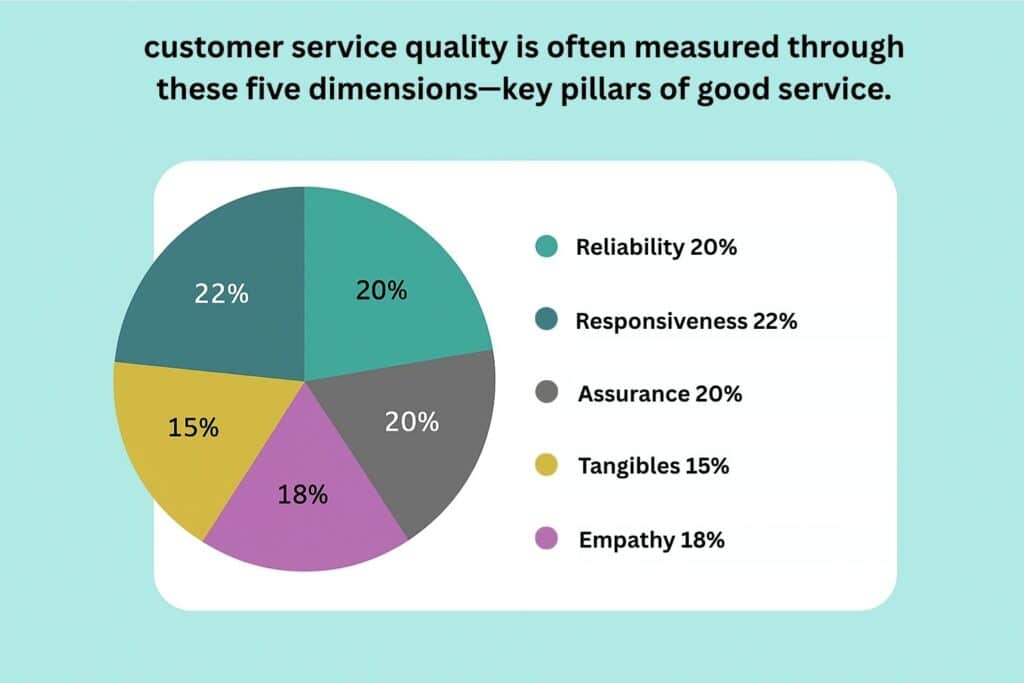
What SERVQUAL Emphasizes in Customer Service
• Reliability 20%
• Assurance 20%
• Tangibles 15%
• Empathy 18%
• Responsiveness 22%
Source: wikipedia
Customer satisfaction scores are a powerful indicator. They reflect how well your customer service team meets customer expectations—and studies confirm that high scores correspond with client loyalty.
Customer satisfaction scores are a powerful indicator. They reflect how well your customer service team meets customer expectations—and studies confirm that high scores correspond with client loyalty.
What we provide
Virtual Medical Administrative Assistant
Medical Virtual Receptionist
Remote Medical Scribe
Medical Billing Virtual Asssistant
Executive VA & Virtual Office Manager
Virtual Dental Administrative Assistant
Dental Virtual Receptionist
Remote Dental Scribe
Dental Billing Virtual Assistant
Virtual Dental Executive Assistant
Patient Care Coordinator
Prior-Authorization
Provider Support
Telehealth Specialist
Telephone Triage
Remote Patient Monitoring
Customer Service Skills: What Reps Must Master
Key client service skills include empathy, communication, patience, adaptability, and product knowledge. These are essential for delivering exceptional customer service.
Customer Expectations: The Starting Point
Modern customer expectations include fast replies, personalized treatment, and digital convenience. Your goal should be to deliver exceptional service that meets customer needs and exceeds these expectations.
Seamless Customer Experience: No Friction, Just Flow
A smooth customer experience means smooth transitions between website, phone, chat, or in-store interactions. Consistency is key to client satisfaction and loyalty.
Customer Loyalty: The Ultimate Reward
Customer loyalty comes when satisfied customers enjoy every service interaction and feel valued. Loyal customers often cost less to serve, spend more, and advocate for your brand, driving business growth.
How Should Customer Service Teams Handle Problems?
Strong customer service does not mean that problems never occur.
It means the organization has a reliable process for responding when they do.
A good problem-resolution workflow should:
- Identify the issue.
- Confirm the relevant information.
- Determine whether the representative can resolve it.
- Escalate when necessary.
- Document the action.
- Communicate what happens next.
- Follow up when appropriate.
In healthcare, representatives should never guess about clinical, billing, privacy, or other issues outside their authorized scope.
Clear escalation procedures protect both the patient and the practice.
What Skills Make a Good Customer Service Representative?
A strong customer service representative combines interpersonal skills with dependable operational habits.
Important skills include:
- Active listening
- Clear verbal communication
- Professional writing
- Empathy
- Patience
- Attention to detail
- Problem solving
- Organization
- Adaptability
- Appropriate escalation
- Familiarity with organizational procedures
For healthcare roles, familiarity with medical terminology, practice workflows, scheduling systems, EHR or EMR platforms, patient privacy requirements, and professional telephone etiquette can be especially useful.
Medical Staff Relief’s Virtual Medical Receptionist service is designed specifically around healthcare front-desk workflows, patient calls, scheduling, message routing, and administrative communication.
How Can Healthcare Practices Measure Customer Service?
Healthcare organizations should measure customer service instead of relying only on impressions.
Useful operational metrics can include:
| Metric | What It Helps Measure |
|---|---|
| Average response time | How quickly requests receive attention |
| First-contact resolution | How often routine issues are resolved without additional contacts |
| Abandoned-call rate | How many callers disconnect before receiving help |
| Appointment accuracy | How consistently scheduling is handled correctly |
| Message turnaround | How quickly messages reach the appropriate team |
| Patient complaints | Recurring sources of dissatisfaction |
| Patient feedback | How patients describe their experience |
| Follow-up completion | Whether promised actions actually occur |
Practices can also use patient-experience tools such as the Consumer Assessment of Healthcare Providers and Systems (CAHPS) resources developed by AHRQ.
A First-Hand Example From Medical Staff Relief
Medical Staff Relief was created after founders Dr. Ricardo Abraham and Gimena Abraham experienced the operational challenges of running a medical clinic in Brownsville, Texas. Their experience with administrative strain led them to develop a remote staffing model designed specifically for healthcare practices.
You can learn more about the company’s background on the Medical Staff Relief Who We Are page.
Medical Staff Relief currently reports serving 215 medical practices, onboarding 287 virtual assistants, maintaining a 94% VA retention rate, and generating an estimated $4.5 million in client cost savings during 2024. These company-reported figures reflect MSR’s experience providing administrative support to healthcare teams and should not be interpreted as guaranteed results for every practice.
These figures provide first-party evidence of Medical Staff Relief’s experience rather than relying exclusively on third-party customer-service statistics.
Take Action Now: How We Can Help You
If you’re ready to elevate your client service team and deliver exceptional service, our experts can help. We offer tailored training, process design, and measurement tools that ensure customer satisfaction and drive loyal customers.
• Schedule a free consultation today and start boosting your client satisfaction scores.
• Download our guide: “10 Steps to Exceptional Customer Service.”
• Join our webinar: “Transform Your Customer Service into a Growth Engine.”
How Can Virtual Assistants Support Better Patient Service?
Healthcare teams frequently manage phones, appointments, insurance questions, referrals, documentation, messages, and follow-up alongside their clinical responsibilities.
Delegating appropriate administrative work can give practices more consistent coverage for these recurring tasks.
Depending on the role, remote healthcare staff can support:
- Patient phone calls
- Appointment scheduling
- Reminder calls
- Message routing
- Referral coordination
- Insurance verification
- Administrative follow-up
- Inbox management
- EHR administrative updates
- Patient outreach
Explore Medical Staff Relief’s medical virtual assistant services to see how remote administrative support can fit within an existing healthcare workflow.
What Is the Difference Between Customer Satisfaction and Patient Experience?
Customer satisfaction asks whether someone’s expectations were met.
Patient experience focuses more specifically on what actually happened during healthcare interactions.
AHRQ explains this distinction in its guidance on patient experience.
For example, a patient-experience question might ask whether staff explained something clearly or whether an appointment was available when needed.
A satisfaction question may instead ask whether the patient was satisfied overall.
Both can provide useful information, but they measure different things.
FAQ
Good customer service means listening carefully, communicating clearly, responding promptly, solving problems accurately, following through on commitments, and treating people with respect.
The most important qualities include communication, empathy, reliability, responsiveness, active listening, problem solving, consistency, and appropriate follow-up.
In healthcare, good customer service means making administrative interactions easier for patients through timely access, respectful communication, accurate scheduling, clear information, reliable follow-up, appropriate privacy safeguards, and effective coordination.
Patients often rely on administrative teams for appointments, messages, referrals, instructions, insurance questions, and updates. Clear communication helps them understand what will happen next and reduces unnecessary confusion.
Practices can improve service by establishing communication standards, monitoring response times, training staff, documenting workflows, setting escalation procedures, collecting patient feedback, and assigning clear ownership of recurring administrative tasks.
Yes. A trained virtual medical assistant can support approved non-clinical responsibilities such as answering calls, scheduling appointments, routing messages, following up with patients, managing inboxes, and coordinating administrative tasks.