
Why this is trending now in 2026
 Ambient AI scribing is trending because the healthcare system is trying to solve a real choke point: medical records load is rising while clinician capacity is not. In many clinics and every department especially the emergency department in an emergency the EHR becomes the hidden “second shift,” and assistants need knowledge of medical context inside electronic health records, or it shows up as lateness, inconsistent notes, slower flow, and exhaustion.
What’s different today is that ambient tools are no longer “nice-to-have” experiments. They’re treated as a workflow layer to assist the clinical conversation, draft documentation, and cut work that breaks focus during the examination. That’s why large systems (including the VA) discuss how scribes work and work alongside the healthcare professionals in electronic medical records more eye contact, less screen time.
 How Pajama Time Gets Created: The Operational Burnout Loop
 How Pajama Time Gets Created: The Operational Burnout Loop
Burnout is often framed as emotional fatigue, but in clinics it’s frequently operational fatigue. The common pattern is:
This section explains “pajama time” as an operational loop, not a personal failure: visits run behind, documentation gets deferred, thin notes trigger rework (clarifications/addenda/delays), and the day extends into after-hours charting. The core takeaway is that after-hours work drops fastest when you reduce rework, by tightening note standards, protecting review time, and clarifying handoffs.
If you’ve ever asked “what is medical scribe job”: here’s the burnout answer
In classroom duty, medical scribe builds notes so you focus more intently on follow-up appointments, including emergency, quickly and accurately not paperwork.
A scribe supports the clinician by capturing key elements of the encounter in real time (or near real time), organizing the narrative clearly, and aligning the recordkeeping with the provider’s style. That matters because many providers don’t burn out from medicine, they burn out from “closing the loop” on record after the work is supposed to be done.
In 2026, medical scribes may increasingly function as a quality layer. Whether your clinic uses a human scribe, a virtual scribe, ambient AI, or a hybrid, someone must keep notes accurate, consistent, and complete enough to prevent follow-up chaos capturing vital signs, using medical technology, and reducing administrative drift that becomes inbox volume later.
The 3 protections model that actually reduces pajama time
Clinics tend to chase one fix: “we need AI” or “we need a scribe.” The clinics that succeed build three protections.
Protection 1 — Protect the visit (reduce live friction)
During the encounter, the goal is to preserve clinician attention and patient connection. That’s where a scribe workflow (human or virtual) or ambient AI can reduce clicks, capture the story, and prevent the clinician from toggling between patient and keyboard.
But protecting the visit also means protecting focus. If the provider is constantly interrupting messages, phone calls, “can you quickly answer this?” the visit becomes fragmented, and fragmented visits produce fragmented notes.
Protection 2 — Protect the note (standardize + QA)
The biggest failure mode in record improvements is skipping the quality layer. An AI draft is not the finished note. A scribe-captured note still needs a quick clinician review. Standardization means you have consistent templates, consistent phrasing for common problems, and a predictable structure that makes notes easy to review and hard to misinterpret.
Protection 3 — Protect the team (role clarity and handoffs)
Burnout rises when tasks lack owners. Without up-to-date patient information, doctors and other healthcare providers lose efficiency and flexibility to document various medical symptoms quickly and accurately hurting competitive healthcare delivery.
Human scribe, virtual scribe, or ambient AI—what’s the best fit?
The right model depends on your clinic reality, not trends.
Human or virtual scribe is best when
You need specialty nuance and consistent notes across providers. This is common in practices where recordkeeping quality shapes referrals, imaging, and procedure planning. A scribe can document patient encounters, work alongside physicians and adapt to clinical style valuable real hands-on experience for those who pursue this role.
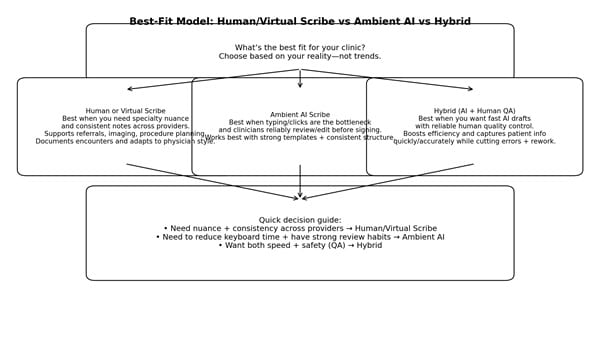
Ambient AI is best when
Typing and clicks are the bottleneck and your clinicians reliably review and edit drafts before signing. Ambient AI can be powerful in reducing “keyboard time,” but it works best when the clinic already has templates and a consistent note structure to anchor output.
Hybrid wins when
You want the speed of AI drafts with the reliability of a human QA layer. In many clinics, hybrid is the smoothest transition: AI boosts efficiency, and a scribe/QA process with flexibility helps doctors and other healthcare teams capture various medical patient information quickly and accurately, cutting errors and rework.