
What WISeR Means for Your Medical Practice: Virtual Medical Assistant + Medical Billing Impact
CMS describes WISeR as a multi-year model in six states aimed at reducing waste and encouraging safe, evidence-supported practices. In the real world, that typically translates into tighter scrutiny of documentation quality and “clean packets” that match payer checklists because the easiest request to approve is the one that arrives complete and consistent from the medical office the first time. That means more administrative tasks must be done correctly up front using the right medical terminology, aligning notes to payer criteria, and ensuring every attachment is complete and readable.
Operationally, every healthcare practice should prepare for tighter timelines, more frequent status checks, and a higher volume of “where are we on this?” patient calls especially when appointments, imaging, procedures, or medications depend on payer decisions. This also increases the workload around managing patient records, since teams need clean documentation, accurate tracking, and consistent updates that are easy to audit. And even if you aren’t in a WISeR state, payer behaviour tends to spread best practices and burdens across markets, so healthcare providers that prepare now avoid costly catch-up later.
The hidden downstream effect on billing and revenue
Sloppy prior auth makes billing messy delays, reschedules, denied claims. With evolving needs, clean PA packets are crucial for accurate decisions, seamless integration with scheduling/billing, and delivering quality care. Better tracking reduces the need for frantic callbacks; patients feel valued, building trust and loyalty.
Virtual Medical Administrative Assistants Benefit: Faster Approvals With Fewer Denials
Prior auth is one of the highest-leverage areas for smart delegation because most of it is administrative tasks and operational precision not clinical judgment. Virtual Medical Administrative Assistants benefit a medical practice when a virtual medical assistant or virtual assistant takes ownership of prior-authorization submissions, payer follow-ups, and documentation packaging so approvals move faster, teams optimize throughput, and clinicians spend less time chasing payers. In practice, virtual medical assistants help by managing status tracking, confirming receipt, and keeping patient updates consistent while maintaining compliance with healthcare regulations and payer requirements.
When the PA workload is owned by virtual support, your providers and in-house team stay focused on treatment decisions while the admin lane ensures the right codes, the right notes, and the right attachments are submitted exactly how the payer expects them. That reduces delays, lowers rework, improves coordination for medical billing and insurance, and supports cleaner handoffs for handling medical billing, turning prior authorization into a predictable system run through essential administrative duties instead of a constant interruption. It also protects patient satisfaction by reducing uncertainty, improving communication, supporting accurate patient data handling, and preventing schedule chaos that spills into appointment scheduling.
The three PA tasks that quietly crush staff time
Packet assembly gets complex with payer rules across multiple plans.
 The time disappears in small details: ensuring the CPT/ICD pairing is correct, completing insurance verification, attaching clinical notes that explicitly support the payer’s criteria, and confirming that required imaging or lab documentation is included without gaps that trigger a denial or a “request for more information.” For the overall patient experience, that precision matters because delays ripple across the healthcare system, creating avoidable friction for an effective patient journey and extra work for in-office staff.
The fix is repeatability: a consistent packet standard that makes it hard to miss something and streamlines administrative processes especially when virtual teams are adept at handling communication and follow-ups, status checks, and patient updates.
When every request follows the same checklist logic codes verified, notes matched to criteria, and supporting docs bundled correctly you reduce back-and-forth, speed determinations, and prevent denials that come from missing basics rather than clinical appropriateness. This is enhancing operational efficiency in action: your practice can operate more efficiently, while healthcare providers can focus on care and decision-making instead of paperwork, and your process stays consistent from patient registration through authorization and scheduling.
PA status calls and portal follow-ups eat time because they’re rarely “one and done.”
Staff track reference numbers, document every interaction, and chase updates often across phone calls, portals, and faxes while trying not to let requests “age out” or stall unnoticed in a queue.
The fix is cadence. Instead of random checking when someone remembers, you run a scheduled follow-up rhythm tied to payer timelines, with consistent documentation of each touchpoint. That keeps requests moving, builds a defensible record, and prevents silent delays that later become patient frustration and scheduling chaos.
Silence drives call volume; clear updates improve patient experience and trust.
When patients hear nothing, anxiety turns into repeat calls, complaints, and sometimes negative reviews especially if they don’t understand why the clinic “can’t just schedule it” or “can’t just prescribe it.”
The fix is proactive communication that feels calm and specific. A simple update process what was submitted, what the expected timeline range is, and what happens next reduces inbound calls while increasing trust, because the patient feels informed rather than ignored.
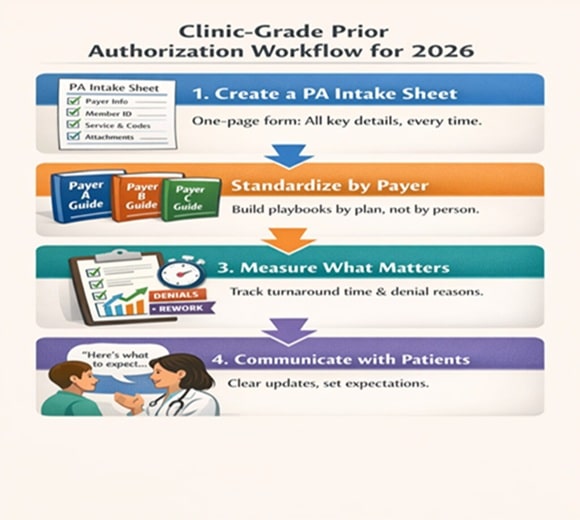
Clinic-Grade Prior Auth Workflow for 2026
A clinic-grade prior auth workflow for 2026 starts with a one-page PA intake sheet (payer/plan, member ID, provider, codes, attachments, submission method + ref #) to create an auditable source of truth. Standardize by payer with mini playbooks, then track cycle times, denial reasons, and rework to fix bottlenecks. Use consistent patient messaging to set timelines, reduce frustration, and cut repeat “any updates?” calls.