
Staffing Strain 2026:Virtual Assistant Standard for Healthcare Practice Health
If your clinic feels like it’s running on adrenaline burned-out staff, nonstop patient calls, and schedules that break daily you’re not failing. You’re carrying a workload your systems were never built to hold, and virtual assistants in healthcare are quickly becoming the fastest way practices stabilize operations without burning out their team.
Medical Staff Relief installs virtual assistants in healthcare that take intake, scheduling, referrals, and patient messaging off your plate in 7–14 days, so your team can breathe again, patients get faster answers, and revenue stops leaking through missed calls and delays.
Staffing pressure in the United States hasn’t disappeared it’s simply evolved to manage new challenges. Clinics are balancing high patient demand, tighter margins, and rising expectations for fast access, all while seeking reliable staffing solutions to avoid struggle and drive growth. When schedules get tight, phones spike, staff turnover rises, and small delays become system-wide friction, it is crucial to maintain a commitment to efficient workflow management. That’s why more medical professionals are building hybrid support models that protect clinicians and front-desk teams while maintaining patient trust.
Why this is trending right now (and what medical professionals are seeing)

Healthcare workforce strain remains a major operational storyline, and practice leaders are responding with practical productivity moves not “shiny tech.” The most common response is not replacing teams, but redesigning workflows so repetitive administrative work stops consuming clinical energy. Many practices are also planning around variability—knowing staffing may fluctuate so they build systems that keep the clinic stable even when hiring is slow or seasonal volume surges, seeking reliable staffing solutions.
That’s why more clinics are turning to virtual assistants in healthcare to take ownership of repeatable admin lanes—intake, scheduling hygiene, referral tracking, and patient updates—so clinicians stay focused on care while operations stay consistent even on understaffed days.
What’s changing operationally in 2026 (the real shifts)
Hybrid staffing is becoming normal
Instead of treating remote support as a temporary fix, more clinics now build it into standard operations. Onsite teams stay focused on patient-facing tasks and real-time coordination, while remote staff handle repeatable administrative lanes that don’t require physical presence. Done well, this reduces bottlenecks without degrading the patient experience, ultimately benefiting the overall service.
“Staffing variability” planning is replacing “perfect staffing” hope
A growing number of practices are accepting that staffing stability isn’t guaranteed, which drives the need for open-access solutions to retain talent. Rather than waiting for the ideal hire to appear, they build workflows that can absorb call spikes, referral volume, and prior authorization demand away from patient care, taking chronic fluctuations into consideration. The goal becomes resilience: the clinic runs smoothly even when the day is chaotic, providing a reliable advantage in patient care.
Automation is being judged by outcomes—not hype
The conversation has shifted from “use automation” to “does it shorten the cycle?” Tools only help if they reduce resolution time, cut rework, and make the patient experience smoother. If automation simply deflects patients or creates dead ends, it increases call volume and frustration instead of reducing it.
Where virtual assistants in healthcare create the biggest lift
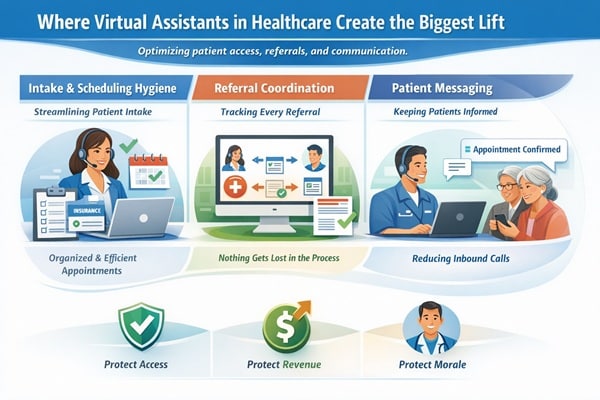
Practices get the best results when virtual support owns a clear lane with documented rules that enhance the role of the medical assistant and drive compliance. Instead of doing “a little bit of everything,” the virtual team runs predictable workflows that protect access, protect revenue, and protect staff morale while addressing chronic demands.
This works because ownership eliminates guesswork. Everyone knows what “done” looks like, what gets escalated, and how updates are communicated—so patients get consistent answers and your in-house team isn’t pulled into constant fire drills.
Intake and scheduling hygiene (the access-protection lane)
When intake is inconsistent, everything downstream requires more effort, creating an additional burden on the cost of service delivery. Virtual assistants can handle new patient intake, insurance capture, appointment confirmations, and reschedules using a standardized checklist to reduce the burden on the schedule and sustain efficiency. Over time, this reduces same-day chaos in patient care because fewer patients arrive with missing data, unclear expectations, or unresolved eligibility issues, supporting compliant operations.
Referral coordination (the “nothing gets lost” lane)
Referrals are a silent source of patient frustration when updates are unclear or paperwork goes missing, posing a challenge for service delivery management and monitoring. A virtual team can track inbound and outbound referrals, follow up on missing documentation, coordinate status updates, and keep a visible log that any staff member can check to improve service monitoring. This prevents the classic failure mode where a patient calls and no one knows where the referral stands, ensuring data entry is accurate and timely.
Patient messaging (the “silence becomes volume” problem)
When patients don’t receive updates, they create their own follow-up system—calling repeatedly, which adds to the burden on the staff. Virtual assistants can send proactive, consistent messages at key points: “we received your request,” “we’re waiting on X,” and “your next step is Y.” This reduces inbound calls while improving the patient experience because people feel informed instead of ignored.
What we provide
Virtual Medical Administrative Assistant
Medical Virtual Receptionist
Remote Medical Scribe
Medical Billing Virtual Asssistant
Executive VA & Virtual Office Manager
Virtual Dental Administrative Assistant
Dental Virtual Receptionist
Remote Dental Scribe
Dental Billing Virtual Assistant
Virtual Dental Executive Assistant
Patient Care Coordinator
Prior-Authorization
Provider Support
Telehealth Specialist
Telephone Triage
Remote Patient Monitoring
What to keep in-house (so quality and trust don’t slip)
Not everything should be outsourced or delegated, especially when it comes to critical aspects of physician care. Clinical decision-making stays with clinicians. Symptom triage, complex care coordination that requires real-time presence, and provider-to-provider communication typically stay internal to ensure public health. The right split is the one that protects patient safety and preserves the human moments—while removing the repeatable administrative grind that burns teams out.
A simple 7–14 day implementation plan (clinic-ready, not theory)
Week 1 — Map the bottleneck and assign one lane
Start by identifying the single most painful bottleneck: phones, intake, referrals, prior auth support, or patient messaging. Define what “done” looks like and document the checklist to manage expectations effectively. This is the difference between a virtual assistant being helpful in patient care versus being another moving piece.
Week 2 — Scripts, escalation rules, and QA go live
Before going live, build scripts for top call types and write escalation rules so the team knows exactly what to route to clinical staff, minimizing the risk of error. Then add a QA loop for the first two weeks to ensure the quality of service provided. Small daily feedback fixes engage the team and ensure your workflow becomes consistent, not improvised, offering a sustainable solution away from patient care while considering chronic issues and retaining staff.
The Medical Staff Relief model (doctor-founded, team-powered)
At Medical Staff Relief, our journey started with Dr. Ricardo Abraham, a seasoned internal medicine practitioner who experienced operational breakdowns firsthand and sought reliable solutions. He built a dedicated remote team that transformed his own medical practice by stabilizing the work that causes daily fire drills—phones, intake, scheduling friction, and workflow gaps, ultimately benefiting public health. Today, we extend that same clinic-tested operating model to other practices, tailoring workflows that improve efficiency and increase satisfaction for both patients and healthcare providers in the latest market.
Key takeaways (for busy medical professionals)
Staffing strain is no longer a temporary phase—it’s a design constraint that increases the burden on management. The practices that win in 2026 are the ones that protect clinician time, tighten workflows, and keep patients informed without creating more work for the internal team. Virtual assistants in healthcare provide a reliable resource for managing chronic administrative tasks effectively, driving compliance and efficiency in data entry. Work best when they own a defined operational lane, follow scripts and escalation rules, and run a consistent QA loop to sustain quality, which helps retain staff and improve service.
FAQ
Not a healthy model for managing patient care. They reduce overload by owning repeatable tasks so your internal team can focus on in-person coordination, complex calls, and patient-facing moments that require human trust, especially in chronic situations.
For many clinics, it’s intake/scheduling or patient messaging that require effective management solutions. These lanes directly reduce missed calls, reduce no-shows, and lower repeat follow-up volume—often creating quick operational relief and enhancing patient medication adherence.
Use role-based access, standardized scripts, escalation rules, and QA reviews to ensure compliance and minimize error in data entry processes. The safest workflows avoid “free styling” and instead use consistent templates and approved language to enhance patient care.
They assign random tasks without defining a lane, checklist, ownership, and quality assurance requirements for effective billing management. That creates inconsistency in service and makes the virtual team feel like an extra variable instead of a stabilizer, increasing the burden on the overall management and hindering growth.
Conclusion
In 2026, the question isn’t whether staffing pressure will ease—it’s whether your clinic is built to stay steady when volume rises and the day gets unpredictable, ensuring reliable patient care. The most sustainable practices protect people by protecting the workflow that is essential for effective patient care management, ensuring compliant operations. When implemented with clear lanes, scripts, escalation rules, and quality assurance, the role of the medical assistant becomes a key requirement for efficient management and compliant patient care. virtual assistants in healthcare can stabilize access, reduce patient frustration, protect revenue, and give clinicians more of their time back during each session.
Ready to experience the difference Medical Staff Relief can offer for your practice by providing compliant staffing solutions?